
October 2026: Closing out my 2026 conference season was the SHOT annual meeting held virtually in October. Joining with Andra Sonia Petrutiu, a doctoral candidate at Cornell University, we organized a session titled Supercomputers and the History of Technology comprised of seven presentations. My talk was titled When multitasking became social and what did supercomputers have to do with it? where I suggest that the ability of computer systems from the 1960s and early 1970s to support the concurrent execution of multiple jobs, programs, and tasks by one or more central processing units played a pivotal role in propelling this technical word into greater and wider use.
September 2026: I enjoyed a summer of travel in Europe ranging from waterfalls in Iceland to hanging out with Albert Einstein in Switzerland.
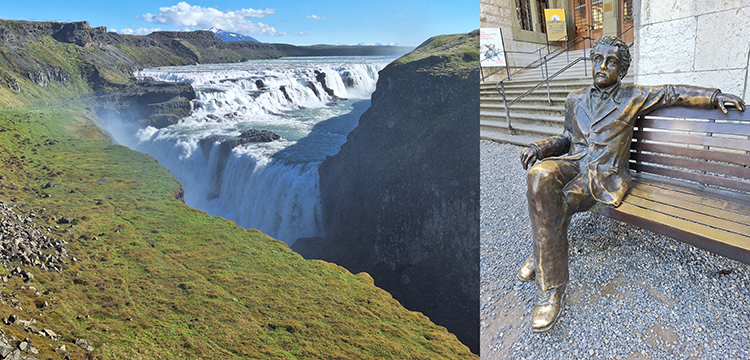
As if twenty counties over 105 days wasn’t enough, I also folded in two conferences along the way. The large HSS/ESHS conference in Edinburgh, Scotland, in July was well attended with nearly 2000 registered participants. This gathering gave me the chance to hear an abundance of talks and panels along with reconnecting with former grad school classmates and other academic colleagues. The SIC (Scientific Instrument Commission) conference in Neuchâtel, Switzerland, in September was a smaller event in a great location on Lake Neuchâtel where the Alps were visible in the distance. Here I gave a talk titled The center is where you make it: The spectroscopic research of Japanese Physicist Hori Takeo where I explored four episodes of precision spectroscopy research by Japanese physicist Hori Takeo (1899-1994).
August 2026: My short piece titled Richardson’s “GPUs,” circa 1922 appeared in the August 2026 ACM SIGHPC Connect e-newsletter. It contrasts the human computers outlined in Lewis F. Richardson’s 1922 book Weather Prediction by Numerical Process with today’s silicon GPUs. I first explain how Richardson’s offered a “two-fold solution [that] comprised a novel computational architecture combined with the required calculations being done by thousands of human computers,” or Richardson’s GPUs as called them. I then explored the specifics of “what began as a CPU-bound challenge for Richardson” turning into an I/O-bound problem for today’s HPC.
May 2026: Back home from a 16-day Grand Canyon rafting trip arranged with the OARS rowing company. Plenty of big (and small) rapids, fun day hikes, and yummy food, it was a fabulous adventure with the serenity of the Grand Canyon towering overhead every day. The long history of the canyon and the numerous geological layers on view made this journey a delight for a historian of science as well as a welcomed break from the turmoils of the outside world (which were there waiting for us when we exited the river at Pearce Ferry).

February 2026: Since moving to Reno, Nevada, in 2023, I have made it a point to get to know the surrounding area and especially to stop and take time to check out places along the roads I have driven in the past. For example, on a recent trip from Southern California back to Reno I paused at two roadside attractions of minor yet fun note: Cabazon Dinosaur theme park just off I-10 east of Riverside, California, and the Giant Rock in the California Mojave Desert. Not much in the way of history of science to be found at these two locations, but worth the time and gas to investigate something you don’t see every day.

